
Contact Us
The Hematopoietic (Stem) Cell Transplant Program
Fax
617-632-1990
International
+1-617-355-5209
(ALD)
Adrenoleukodystrophy (ALD) is a rare genetic condition that affects males and females differently. In childhood, boys are primarily affected. Girls are not typically affected, though they may develop symptoms as adults.
ALD is caused by mutations in the ABCD1 gene that prevent the body from breaking down very-long-chain fatty acids (VLCFAs). As a result, VLCFAs build up in the brain, nervous system, and adrenal glands.
Learn about how this gene therapy for cerebral ALD, now called SKYSONA, was developed, how it works to stop the disease progression, and the importance of early diagnosis.
There are four types of ALD:
A person can have more than one type of ALD. Most of the information on this page refers to CALD, the type of ALD that affects the brain during childhood.
Cerebral adrenoleukodystrophy, also known as cerebral ALD or CALD, affects the brain, typically during childhood. It occurs in about 1 in 21,000 boys between ages 4 and 10, affecting about 35 to 40 percent of boys with the ABCD1 mutation. Females with the ABCD1 mutation are highly unlikely to develop CALD. Approximately half may develop neurological symptoms in adulthood, but these typically are due to adrenomyeloneuropathy and spinal cord dysfunction, and are not cerebral.
In CALD, VLCFAs build up in the brain and can destroy the protective myelin sheath around the nerve cells that control our muscles, interfering with their ability to communicate with the brain. Untreated, CALD progresses rapidly and can cause permanent cognitive and motor disabilities and death, usually within four to eight years.
The good news is that there are treatments for CALD, including a new gene therapy, that can halt the decline in brain function in CALD and allow children to thrive if given early enough. Many states now include ALD in routine newborn screening, or will be starting soon, allowing the disease to be caught and treated early.

Matthew, one of the first patients to receive gene therapy for ALD in 2013 at age 4, shows no sign of disease activity.
Boys with CALD usually begin showing symptoms between ages 4 and 10. The most common symptoms include:
As the condition progresses, other signs and symptoms of CALD may include:
Without treatment, CALD can progress rapidly, typically leading to a vegetative state or death within a few years.
CALD is caused by a mutation in the ABCD1 gene on the X chromosome. Because a female has two X chromosomes, if she inherits the faulty gene, then she still has another X chromosome to offset the mutation. However, because males only have one X chromosome, the gene abnormality causes the disease.
Pregnant women with an ALD mutation on one of their X chromosomes have a 1 in 4 chance of having a son affected by the disease and a 1 in 4 chance of having a daughter who has the mutation on one X chromosome.
Genetic testing can identify the ABCD1 gene mutation that causes ALD. It also can accurately identify other members of the family who have ALD but may not be showing symptoms.
Early diagnosis of the cerebral form of ALD is critical, because there is a narrow window during which the neurological damage can be prevented. Once the disease progresses, there is no way to replace the lost myelin or reverse the neurological damage already done.
A newborn screening test was added to the United States Recommended Uniform Newborn Screening Panel in 2016 and is currently is available in many states. It detects elevated VLCFA levels in the blood, a clear indicator of ALD. With newborn screening, boys at risk for CALD can be identified and treated early.

On March 16, 2023, Conner became the first CALD patient to receive the gene therapy SKYSONA™ outside of a clinical trial after being diagnosed through newborn screening.
Unless there is a family history of ALD, most affected women aren’t aware they have an ABCD1 gene mutation. Without newborn screening for ALD, boys with CALD are often misdiagnosed, since the symptoms can be mistaken for behavioral or developmental issues.
When clinicians suspect CALD, they will perform tests including a magnetic resonance imaging (MRI) scan to determine whether there is damage to the brain tissue and a blood test to measure the concentration of VLCFAs. Genetic testing may be performed at this time or later. Boys who have ALD have regularly scheduled MRIs to watch for the development of CALD.
Neurologists treat children with CALD. They may prescribe medications, speech therapy, and physical and/or occupational therapy to help improve their functioning. Geneticists and genetic counselors can provide more information and guidance and screen other family members for the ABCD1 mutation.
If CALD is diagnosed early enough — before neurologic symptoms develop or while symptoms are still very mild — there are two very effective treatments: gene therapy and hematopoietic stem cell transplant. Both of these treatments do carry some risks that should be discussed in advance with your care team.
A gene therapy for CALD called SKYSONA™ (elivaldogene autotemcel), clinically pioneered by Boston Children’s and Massachusetts General Hospital, has now been approved by the U.S. Food and Drug Administration. This treatment is for boys with CALD who are experiencing few or no symptoms. It uses boys’ own stem cells, taken from their blood and treated in the lab to replace the defective or missing ABCD1 gene. This restores the body’s ability to break down VLCFAs.
Studies have found that when gene therapy is given early enough, it can prevent or minimize damage to the brain and disability caused by CALD. A key clinical trial in boys ages 4 to 17 with CALD found that about 90 percent of those receiving gene therapy were alive two years later and free of major functional disability (loss of communication, blindness, incontinence, wheelchair dependence, or complete loss of voluntary movement). The boys are still being followed, but this benefit seems to last at least as long as 10 years, as of the most recent follow-up.
The SKYSONA™ treatment is currently available for early, active CALD. To date, there are no specific treatments for advanced CALD, although some drugs are under investigation.
Boys eligible for gene therapy receive a medication to stimulate their production of blood stem cells. Four days later, the stem cells are collected from their blood in the hospital, through a process called apheresis. The cells are treated in the laboratory with a non-infectious virus that goes into the stem cells and delivers a healthy copy of the ABCD1 gene. This treatment process takes eight to 12 weeks.
About 10 days before gene therapy, the child is admitted to the hospital and receives strong chemotherapy drugs to make room in the bone marrow for the treated stem cells. The treated cells, carrying the new gene, are then given back through an intravenous (IV) infusion.
When these new cells engraft, a process that takes two to four weeks, they begin making brain cells that have a healthy ABCD1 gene. The cells are now able to break down the very-long-chain fatty acids that cause the serious neurological symptoms of CALD. The care team will then monitor your child closely for 15 years through clinic visits, either in Boston or at your home institution.
Gene therapy requires hospitalization for about a month, and the chemotherapy regimens can cause nausea, hair loss, vomiting, low blood counts, mouth sores, and fatigue. Because chemotherapy increases the risk for infection and can cause organ toxicity, children are monitored closely during this time.
In addition, SKYSONA™ gene therapy poses a small risk of a complication known as myelodysplastic syndrome, a cancerous condition of blood stem cells. It has occurred in a handful of children so far and requires treatment with a stem cell transplant.
Boston Children’s can provide support in getting the costs of treatment covered. For more information, contact gene.therapy@childrens.harvard.edu.
Stem cell transplant from a genetically matched donor is an established, lifesaving option for CALD that can halt progression of the disease. The purpose is to provide healthy blood stem cells carrying a healthy ABCD1 gene. As with gene therapy, early treatment is crucial; it unfortunately is not effective when disease is already advanced.
As with gene therapy, children undergoing stem cell transplant first receive chemotherapy drugs to make space in the bone marrow for the new blood stem cells. Because the blood stem cells are coming from a donor — known as an allogeneic transplant — the transplant carries different risks than gene therapy. It can be a good therapeutic option if there is a stem cell donor with a similar or identical genetic makeup, preferably a close relative.
Even with a closely matched donor, there is a risk of graft-versus-host disease (GVHD), a life-threatening condition in which the transplanted donor cells see the body as “foreign” and start to attack it. For that reason, children receiving a stem cell transplant must receive strong immunosuppressive drugs to prevent GVHD.
Stem cell transplant and gene therapy each have pros and cons that your care team can discuss with you. SKYSONA™ gene therapy is available only for early stage CALD. With both stem cell transplant and gene therapy, symptoms can progress for some time after treatment until the healthy cells take hold in the body.
For more information on stem cell transplant and gene therapy, watch a Virtual Town Hall hosted by the ALD Alliance. Dr. Christine Duncan, a pediatric stem cell transplant physician at Boston Children’s, discusses both options in depth in the first half of the program.
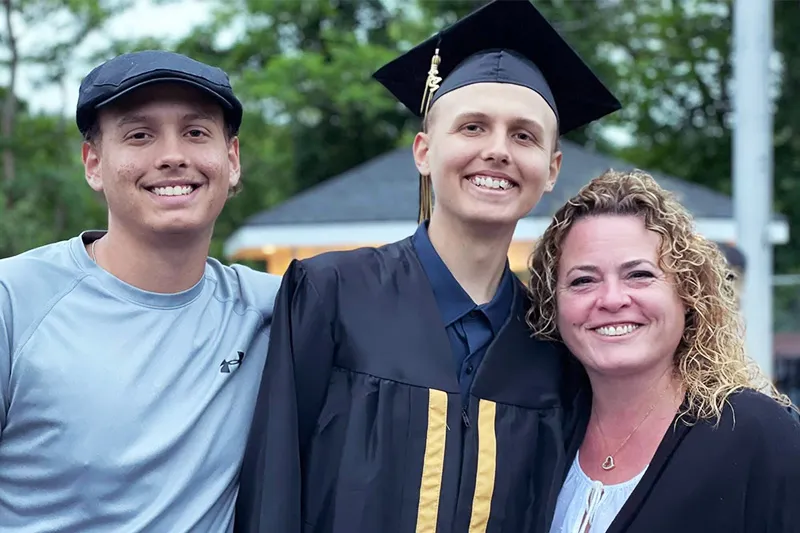
Two brothers have avoided cerebral adrenoleukodystrophy's devastating effects through stem cell transplant and gene therapy, respectively.
Boston Children’s partners with the Leukodystrophy Clinic at Massachusetts General Hospital (MGH) to provide coordinated care for children with CALD. Care begins at MGH with evaluations by neurologists, physiatrists, and physical therapists; brain imaging studies; and consultations with genetic counselors who can help families understand what to expect. Children with adrenal insufficiency, which sometimes accompanies CALD, are seen by an endocrinologist.
Children with CALD who are eligible for gene therapy or stem cell transplant are treated by Boston Children’s dedicated Gene Therapy Program team or Hematopoietic (Stem) Cell Transplant Program team.
Our core team at MGH consists of Florian Eichler, MD, director of the Leukodystrophy Service; neurologist Amanda Nagy, MD; and nurse practitioner Catherine Becker, NP. At Boston Children’s, our core team consists of Christine Duncan, MD, clinical director of Boston Children’s Gene Therapy Program; psychologist Sarah Tarquini, PhD; and Colleen Dansereau, MSN, RN, CPN, director of clinical operations for the Gene Therapy Program. Patients at both hospitals also have access to social work services and help with health insurance.