Popular Search Terms


What is Madelung’s deformity?
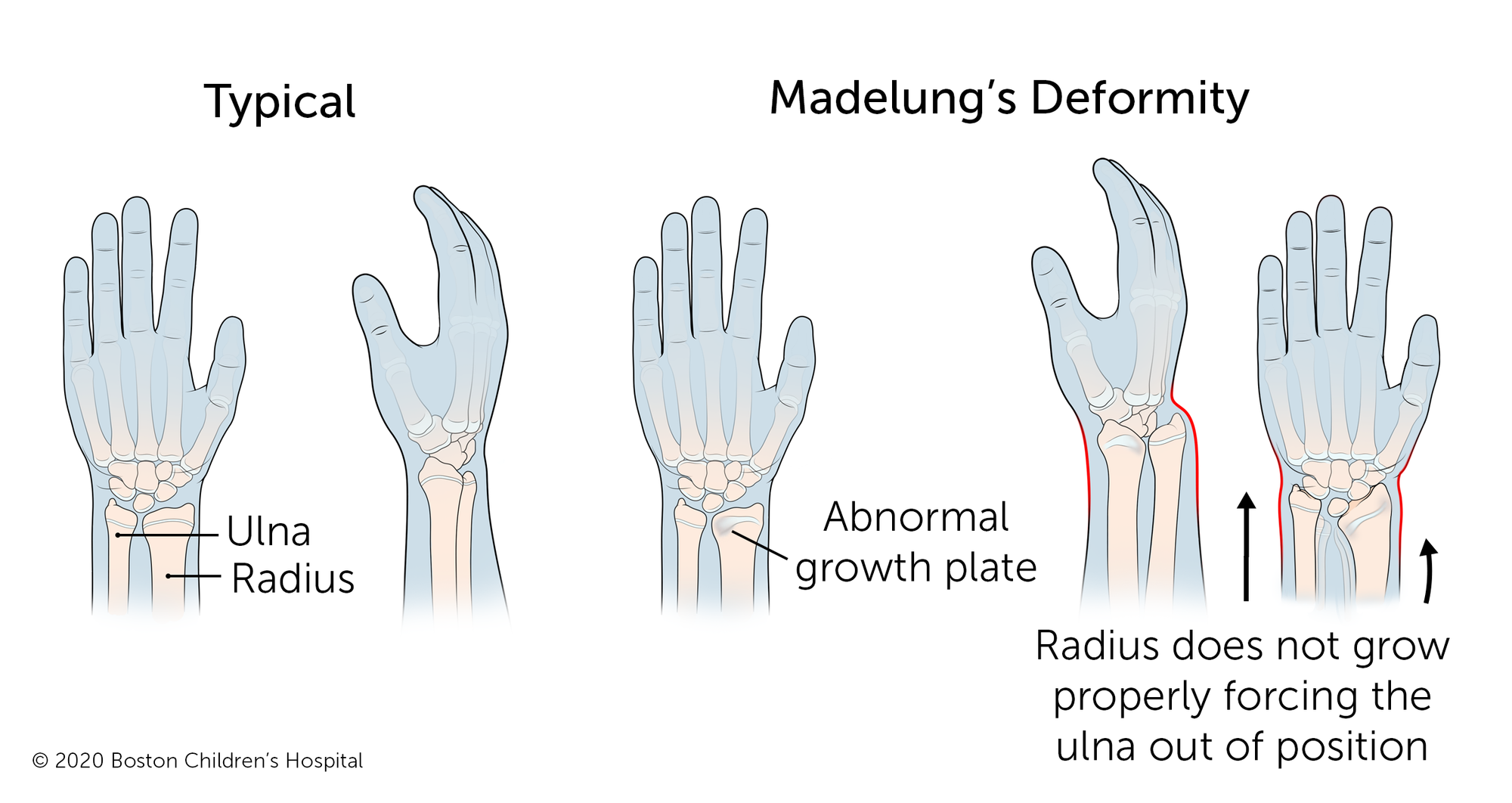
Madelung’s deformity is a rare arm condition that affects the growth plate of the radius, a bone in the forearm. As a child grows, this abnormal growth results in a misalignment where the two long bones of the forearm (the radius and ulna) meet the bones of the wrist.
Madelung’s deformity is a congenital condition, meaning that your child was born with it. However, symptoms often do not appear until the pre-adolescent growth spurt.
The condition usually affects both wrists, though one side may be more severely affected than the other.
Symptoms & Causes
What are the symptoms of Madelung’s deformity?
Symptoms of Madelung’s deformity can range from a slight bulge at the top of the wrist to a complete wrist dislocation. Other symptoms can include:
- Limited range of motion in the wrist
- Wrist pain either after activity or continuously
What causes Madelung’s deformity?
The exact cause of Madelung’s deformity is unknown. It may be because of an abnormal growth plate in the radius. It could also be caused by an abnormality in the ligament that connects the end of the radius to the small bones of the wrist.
Sometimes a trauma or injury to the growth plate at the end of the radius may cause a deformity similar to Madelung’s.
More girls than boys are born with Madelung’s deformity. Researchers believe this may be due to a mutation in a gene on the X chromosome. The condition can be associated with certain genetic syndromes, such as Leri-Weill dyschondrosteosis, Turner syndrome, and nail-patella syndrome.
Diagnosis & Treatments
How is Madelung’s deformity diagnosed?
Madelung’s deformity is usually diagnosed between the ages of 8 and 14, though it is sometimes diagnosed earlier.
As part of the diagnosis, your child will probably have a physical exam and X-rays. Their doctor may order other tests and may refer them to a geneticist if they suspect an associated syndrome.
How is Madelung’s deformity treated?
Many children with Madelung’s deformity have no pain or limitations and do not need treatment. In such cases, their doctor usually recommends regular visits so they can monitor the condition as the child grows.
If your child develops pain, has trouble using their wrist, or if the deformity gets worse, their doctor may recommend surgery.
In general, the goal of surgery is to reposition and stabilize your child’s wrist so they can move it without pain. Surgery also aims to prevent the deformity from getting worse.
The type of surgery depends on your child’s age and general health, the severity of Madelung’s deformity, and how well your child can move and use their wrist.
Types of surgery for Madelung’s deformity
- Physiolysis: Releases or corrects the growth plate abnormality when your child is young to prevent the wrist deformity from becoming more severe.
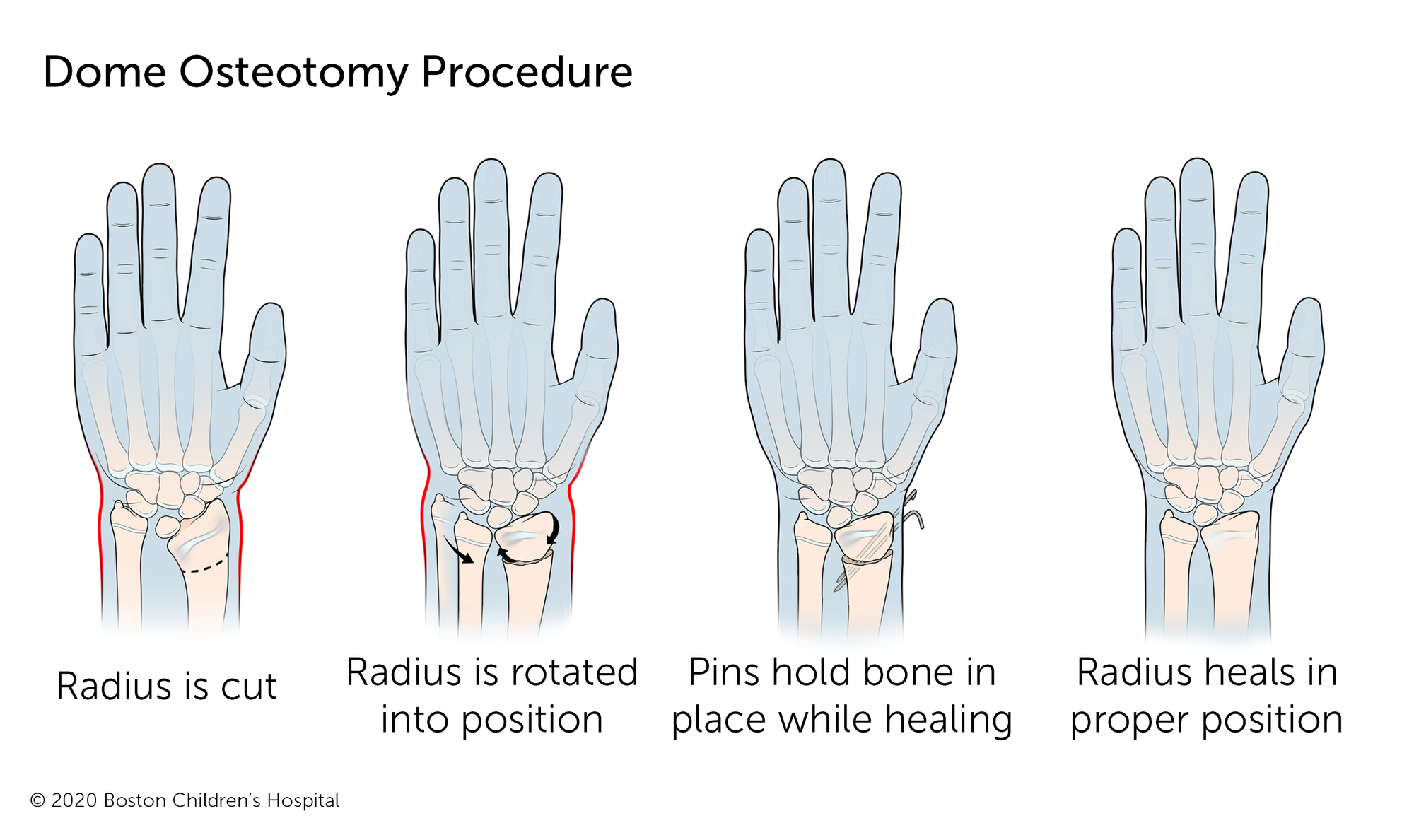
- Dome osteotomy of the wrist: The end of the radius is cut and realigned so it can better support the small bones of the wrist.
- Ulnar-shortening osteotomy: The ulna bone is shortened to level out the wrist. This can be done as a stand-alone procedure or at the same time as a radius osteotomy.
- Darrach procedure: The part of the ulna that sticks out is removed. This is rarely performed in young patients.
- Wrist arthroscopy: A camera is inserted in the wrist to evaluate and treat any cartilage injury within the joint that may have been caused by the abnormal alignment. Wrist arthroscopy is typically performed in conjunction with other procedures for Madelung’s.
How we care for Madelung’s deformity at Boston Children’s Hospital
The Orthopedics and Sports Medicine Department’s Hand and Orthopedic Upper Extremity Program and our Department of Plastic and Oral Surgery’s Hand and Reconstructive Microsurgery Program have treated thousands of babies and children with Madelung’s deformity and other upper extremity issues. We treat conditions that range from routine to highly complex and can provide your child with expert diagnosis, treatment, and care. We also offer the benefits of some of the most advanced clinical and scientific research in the world.
Our Orthopedics and Sports Medicine Department is nationally known as the preeminent center for the care of children and young adults with a wide range of developmental, congenital, neuromuscular, sports-related, traumatic, and post-traumatic problems of the musculoskeletal system.
Our Department of Plastic and Oral Surgery is one of the largest and most experienced pediatric plastic and oral surgery centers anywhere in the world. We provide comprehensive care and treatment for a wide variety of congenital and acquired conditions, including hand deformities.