Popular Search Terms


What is thoracic insufficiency syndrome?
Thoracic insufficiency syndrome is a chest wall deformity that interferes with lung function and development. Children with thoracic insufficiency syndrome are born with the condition, which tends to get worse as they grow. In most cases, they are also born with congenital scoliosis. Less often, thoracic insufficiency syndrome is related to kyphosis or disorders such as Jeune syndrome. Many children with thoracic insufficiency syndrome have missing ribs or have ribs that fused together.
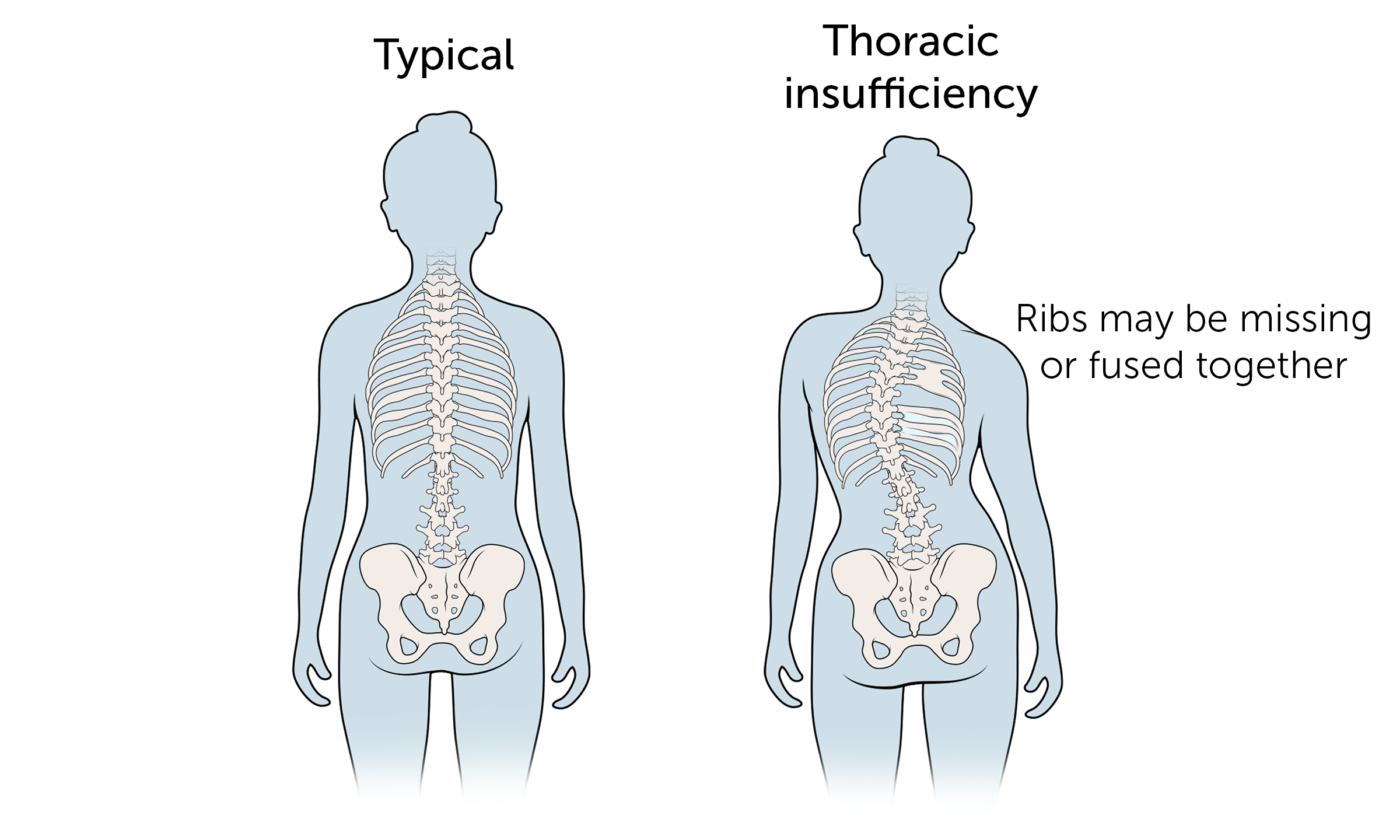
Thoracic insufficiency syndrome is rare. Fewer than 4,000 children are born with the condition in the U.S. each year. However, it is a serious condition that requires close monitoring and treatment.
Symptoms & Causes
What causes thoracic insufficiency syndrome?
Most cases of thoracic insufficiency syndrome are related to congenital scoliosis. Severe childhood kyphosis can also distort the shape of the chest wall and interfere with the lungs.
Other, less common causes include:
- Skeletal dysplasia or achondroplasia, also known as dwarfism or short stature
- Neuromuscular disorders that cause spine and chest deformity such as muscular dystrophy
- Spina bifida, a birth defect that affects the spine and spinal cord
Whether the condition is related to scoliosis or another problem, children with thoracic insufficiency have small chest cavities and usually lean significantly to one side due to the associated scoliosis. Because their lungs do not have enough room to function, children with thoracic insufficiency syndrome have a hard time breathing. Further, their small chest cavities do not give their lungs space to develop as they should.
What are the symptoms of thoracic insufficiency syndrome?
Symptoms of thoracic insufficiency syndrome usually appear in early childhood and get worse over time. Symptoms include:
- Shortness of breath
- Getting winded from easy activities
- Fast, shallow breathing, even at rest
- Disrupted sleep caused by breathing problems
Diagnosis & Treatments
How is thoracic insufficiency syndrome diagnosed?
Thoracic insufficiency syndrome is almost always diagnosed when children are younger than 5 years old. The physician will start with a medical history, asking about your child’s symptoms and family health history. During a physical exam, the physician will assess your child’s spine and the size and shape of their chest, checking for visible signs of deformity. The physician may also order a series of tests to confirm the diagnosis.
- CT or CAT scan (computerized tomography scan) uses a combination of imaging and computer technology to produce detailed cross-sectional images of bones, muscles, fat, and organs.
- MRI (magnetic resonance imaging) uses a combination of large magnets, radio frequencies, and a computer to produce detailed images of organs and structures within the body. MRIs take longer than CT scans but produce more detailed images that can help identify or rule out skeletal abnormalities.
- A pulmonary function test measures the flow of air and oxygen during inspiration and expiration.
How is thoracic insufficiency syndrome treated?
If your child has trouble breathing due to thoracic insufficiency syndrome, they can be given oxygen through nasal delivery or ventilation. However, longer-term treatment requires surgery.
The most common surgical treatment is vertical expandable titanium rib called VEPTR, a relatively new option for children with thoracic insufficiency syndrome. The treatment involves attaching a titanium expandable device to the child’s rib cage to increase the size of their chest cavity. Because they are expandable, VEPTR devices can be lengthened as your child grows.
VEPTR treatment
Treatment with VEPTR involves a series of surgeries that take place over a number of years.
- During the first surgery, a surgeon will enlarge your child’s chest and attach titanium ribs to healthy ribs above and below the deformity. The number of implanted devices and the placement depends on the shape of the chest. Once implanted, the ribs will support your child’s chest wall so their lungs have room to function and develop.
- Your child will need follow-up surgery every six months or so as they grow to have the VEPTR lengthened. These procedures are less invasive than the first surgery. Typically, your child will be able to go home after one night in the hospital.
- After your child has stopped growing in their mid- to late-teens, they will have another surgery to have the titanium ribs removed.

Following VEPTR surgery, some children have spinal fusion surgery to permanently support their spine in an upright position. Your child will need to return for regular check-ups with their orthopedic surgeon throughout their teen years and into adulthood. The doctor will examine your child to ensure their chest and spine remain strong and balanced.
What is the long-term outlook for children with thoracic insufficiency syndrome?
With VEPTR and spinal fusion surgery, many children with thoracic insufficiency syndrome are able to stand up straighter, breathe easier, and gain a level of mobility that would not be possible without treatment.
How we care for thoracic insufficiency syndrome at Boston Children’s Hospital
The Spine Division at Boston Children’s Hospital is the largest and busiest pediatric spine center in the United States. We were one of the first programs in the country to use VEPTR to correct thoracic insufficiency syndrome. Families from around the world come to us for treatment of complex spine problems when they can’t find answers anywhere else.
Treating thoracic insufficiency syndrome typically requires the expertise of a variety of specialties. As part of a large teaching hospital, our orthopedic surgical specialists collaborate regularly with top practitioners in pulmonary medicine, neuromuscular disorders, neurology, and advanced nursing practice, to name a few. Thanks to the depth of our knowledge and access to the extensive resources at Boston Children’s, we successfully treat children with thoracic insufficiency syndrome, as well as many other complex spine issues.
