Popular Search Terms

Research & Innovation
Specialists in ACL care and recovery at Boston Children’s Hospital are leading the way in all aspects of ACL research: from less invasive surgical techniques that reduce the risk of arthritis to psychological considerations, injury prevention, and return-to-play protocols.
Pioneers in ACL surgery for growing bodies
In the past, orthopedic surgeons and sports medicine physicians only rarely recommended surgery for children and young teens with torn ACLs. Reconstruction surgery required the surgeon to drill tunnels through the child’s growth plate, which could disrupt their future growth. Instead, surgeons routinely counseled patients and families to wait until after the child was past puberty to repair a torn ACL. This extended wait limited children’s participation in sports and put them at risk of further injury.
In 1979, Lyle Micheli, MD, developed a surgical procedure to replace the ACL of a toddler born without the ligament. He avoided the growth plate by transferring the patient’s iliotibial band (the ligament running from the hip to the shin) around and into the knee. This operation is now also used in growing children with ACL tears with excellent long-term success and no growth disturbances.
In subsequent studies, Dr. Micheli and Mininder Kocher, MD, MPH, chief of the Sports Medicine Division, have documented the success of this surgery and other procedures developed to reduce the risk of growth plate injury in children and adolescents.
Evaluating ACL treatment strategies
Thanks to the innovations of the past several decades, physicians now have several surgical and non-surgical options for treating patients with torn ACLs. However, they lack information about the long-term effectiveness and safety of these approaches. To close this gap in knowledge, physician researchers at Boston Children’s and nine other centers are conducting a 10-year, multi-site study of ACL treatment strategies.
The PLUTO study (Pediatric ACL: Understanding Treatment Outcomes) is following pediatric patients who have undergone treatment for torn ACLs in order to evaluate the outcomes and effectiveness of various surgical and non-surgical treatments. The study, which began in 2016, will compare the outcomes of four surgical procedures as well as non-surgical treatment to measure the safety and effectiveness of each strategy.
Rather than developing new techniques, this study aims to determine the safety and effectiveness of established procedures. Researchers will look at functional outcomes, activity level, health-related quality of life, graft survivorship, knee stability, knee motion, and growth disturbance. The study aims to provide information that will help orthopedic surgeons select the best possible course of treatment for their patients in the future.
A less invasive way to treat ACL tears: Bridge-Enhanced ACL Restoration (BEAR)
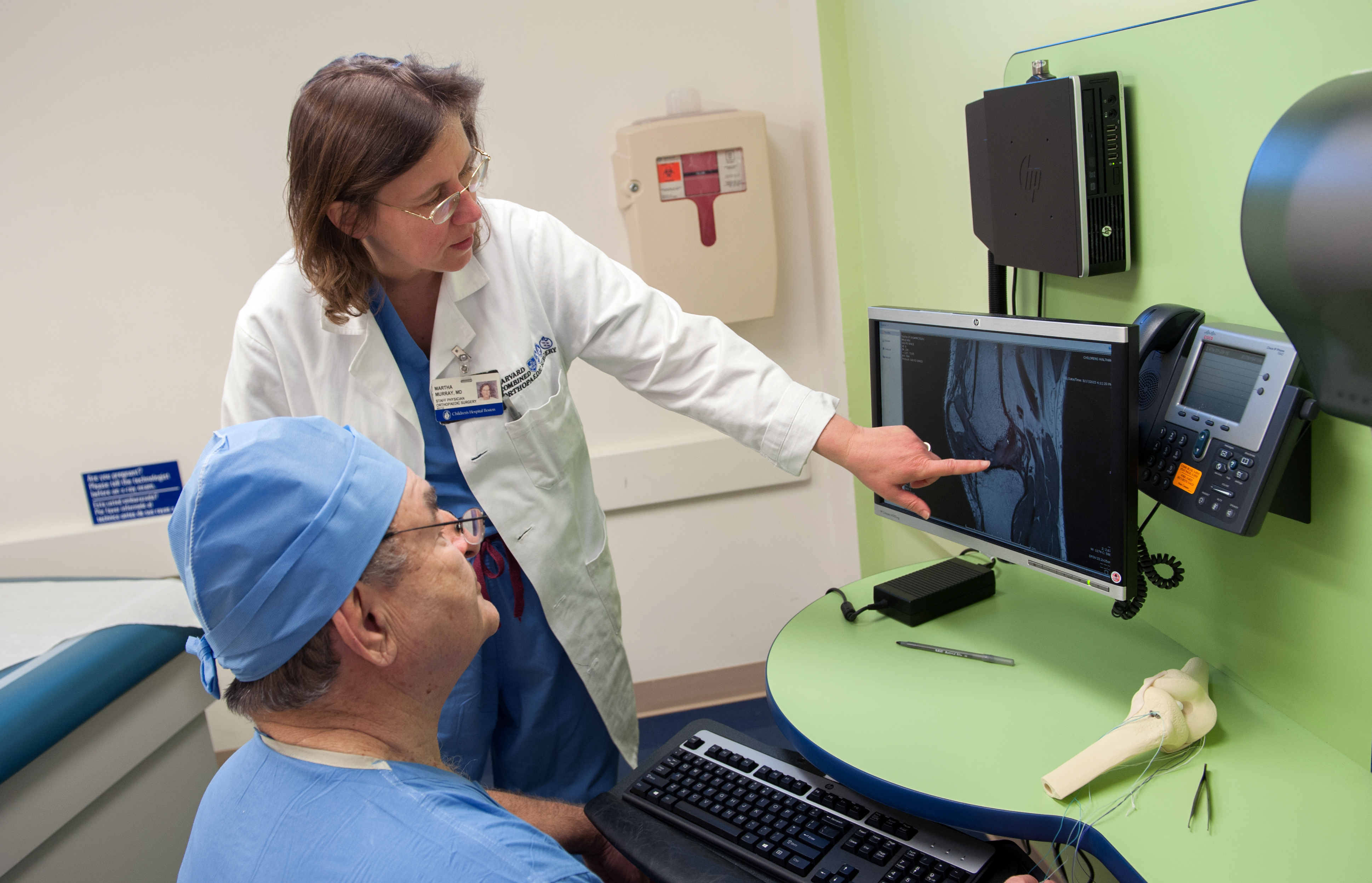
Boston Children’s orthopedic surgeon Martha M. Murray, MD, has developed a new technique called Bridge-Enhanced® ACL Restoration (BEAR) that stimulates healing of the original ligament with stitches and an implant. The implant is a bio-engineered sponge saturated with the patient’s own blood to promote clotting and creating an environment in which torn ACL tissue can grow back together.
Difference between ACL reconstruction and Bridge-Enhanced ACL Restoration
A standard ACL reconstruction is actually two surgeries. First, the surgeon makes an incision in the patient’s leg to harvest a tendon or ligament that will be used as a graft. Second, the surgeon removes the torn ACL and replaces it with the graft. This second surgery is done arthroscopically, through a small incision near the patient’s knee.
For the BEAR procedure, a surgeon makes an incision near the patient’s knee to insert the sponge between the torn ends of the ACL. The rest of the procedure is done arthroscopically. In clinical trials, we are testing the theory that patients who have had BEAR surgery will have a lower rate of reinjury and reduced risk of arthritis in early adulthood.
What is the status of BEAR research?
Supported by data from the following trials, the BEAR implant has been granted marketing approval by the FDA for the treatment of ACL tears.
- BEAR I: The results of our first-in-human study of 20 patients showed that 24 months after surgery, the 10 who underwent the BEAR procedure had improvements in mobility and reduced pain similar to the 10 who had traditional ACL reconstruction surgery. The only significant difference between the two groups was that the BEAR group had significantly greater hamstring strength at follow-up visits after surgery.
- BEAR II: A second study compared 65 patients treated with the BEAR Implant to 35 treated with autograft anterior cruciate ligament reconstruction (ACLR). Two years after surgery, the BEAR Implant resulted in non-inferior patient-reported outcomes and anteroposterior (AP) knee laxity, as well as superior hamstring strength, compared to ACLR.
We are continuing to follow the patients from these trials to monitor longer term outcomes. Miach Orthopaedics, which acquired the license for the BEAR Implant from Boston Children’s Hospital, is conducting additional multi-center trials.
How do I learn more about the BEAR clinical trials?
- If you are already participating in the BEAR I, BEAR II, or BEAR III trials at Boston Children’s Hospital and have questions related to your participation in those trials, call 617-919-4608 or email Bear.Trial@childrens.harvard.edu.
- For other clinical trial questions contact clinicaltrials@miachortho.com.
- For general information on the BEAR implant, visit the manufacturer’s website.
- Read BEAR published research.