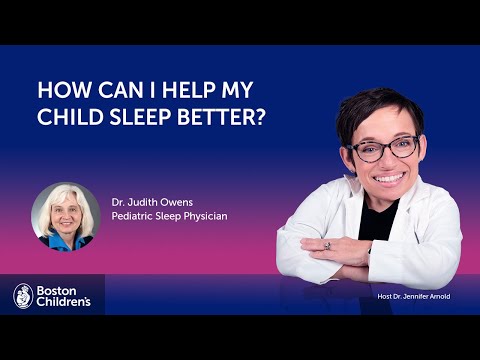
Dr. Judith Owens is featured: How can I help my child sleep better?
Certifications
American Board of Pediatrics (General)
American Board of Pediatrics (Sleep Medicine)
Professional History
I am guided in my professional life by the idea of advocacy, for my own patients and for children in general.
In particular, I am a champion for healthy school start times for all students. Conclusive, evidence-based research shows that better sleep means improved performance, higher executive functioning, fewer car accidents and improved overall health in kids. I am the author of the American Academy of Pediatrics 2014 policy statement on the importance of later school start times for teenagers and I advocate on the topic from Massachusetts to India.
Sleep medicine didn't really exists as a field when I graduated from medical school in 1980. We were not trained to think that children had sleep problems. But as a young pediatrician, I kept seeing all these kids coming in with disordered sleep. I founded one of the country's first sleep clinics for children in 1993.
The Sleep Center at Boston Children's Hospital was one of the first places to take the connection between sleep and health seriously. Now as the center's director, I am committed to expanding our multidisciplinary, evidence-based approach and reaching more families trying to get a good night's rest.
I am also an expert in learning, attention and behavior in children, having directed programs in behavioral pediatrics over the past 20 years at Hasbro Children's Hospital and Brown Medical School in Providence, RI. The connection between ADHD and sleep is of particular interest in my practice.
I completed medical school at Brown University, residency at the Children's Hospital of Philadelphia and fellowships in developmental and behavioral pediatrics, child psychiatry and psychiatry and human behavior. I hold a master's degree in maternal and child health from the University of Minnesota, Minneapolis.
I am the editor in chief of Behavioral Sleep Medicine, one of the sleep field's most respected publications. I am also on the governing council of the World Association of Sleep Medicine. In 2006 I was awarded the American Academy of Sleep Medicine's Excellence in Education Award, and in 2012, was honored to receive the AASM Mark O. Hatfield Public Policy and Advocacy Award.
Approach to Care
I knew from an early age that I wanted to be a doctor. My mother was a strong role model for me, and encouraged me to be anything I could imagine. I never felt that because I was a girl I was limited or that I couldn't pursue science.
I enrolled in a combined undergraduate and medical school program at Brown University, completing both in seven years. Even as a biology major, I loved the humanities and still do—I try to make time to read a history book or biography before I leave for work in the morning. I almost became an obstetrician, and then a psychiatrist, and later pursued a social-science degree in maternal and child health. I have spent much of my career in New England, some as a general pediatrician, and I know what it is like to treat 8,000 ear infections each winter! My broad-ranging intellectual interests are central to who I am and how I approach care, research and advocacy.
I became further solidified by how sleep affects children's health when my own daughter was in high school. The headmaster of her school wanted to shift the school's start time from 8 a.m. to 8:30 a.m.—as a pediatrician and scientist, I suggested studying the effects of that change. The results were remarkable and launched me on a path to advocate for healthy sleep habits for all kids, backed by solid evidence-based research.
As the director of the hospital's Sleep Center, I believe in helping all families struggling with a good night sleep, whether the problem is big or small. I take an individual approach to each family's situation and help parents and kids reach their goals. Changing poor sleep habits can be hard, but the evidence is clear that sleep is key to performance, health and safety.
Publications
Melatonin use in the pediatric population: an evolving global concern. View Abstract
Rethinking pediatric "Periodic Limb Movement Disorder" (PLMD): A clinical review of pediatric PLMD and consensus criteria for an updated pediatric diagnostic category "Sleep Leg Movement Disorder of Childhood". View Abstract
Earlier Bedtimes Mediate the Effect of a Brief Behavioral Sleep Intervention on Children's Weight Status. View Abstract
Associations between indoor fine particulate matter (PM2.5) and sleep-disordered breathing in an urban sample of school-aged children. View Abstract
Behavioral Intervention that Extends Sleep Duration Leads to Greater Self-Control in School-Aged Children. View Abstract
Instructional approach, sleep, and perceived academic well-being in adolescents during COVID-19: Evidence from the NESTED study. View Abstract
Melatonin use in infants and toddlers. View Abstract
Asthma and Sleep-disordered Breathing Overlap in School-aged Children. View Abstract
Periodic limb movement disorder in children: A systematic review. View Abstract
A comparison of caregiver-reported snoring and objective snoring in children from urban neighborhoods. View Abstract
The associations between instructional approach, sleep characteristics and adolescent mental health: Lessons from the COVID-19 pandemic. View Abstract
Adenotonsillectomy for Snoring and Mild Sleep Apnea in Children: A Randomized Clinical Trial. View Abstract
Multilevel Risk Factors for Sleep-Disordered Breathing-Related Symptom Burden in an Urban Pediatric Community-Based Sample. View Abstract
Building a deeper understanding of social relationship health in adolescents with narcolepsy disorder. View Abstract
Con: Home Sleep Studies in Children - Are We There Yet? View Abstract
Adolescent sleep myths: Identifying false beliefs that impact adolescent sleep and well-being. View Abstract
Validation of the Pediatric Narcolepsy Screening Questionnaire (PNSQ): A cross-sectional, observational study. View Abstract
Sleep-Disordered Breathing and Sleep Quality in a Longitudinal Pediatric Cohort. View Abstract
Effect of changes in children's bedtime and sleep period on targeted eating behaviors and timing of caloric intake. View Abstract
Development and Validation of the Pediatric Hypersomnolence Survey. View Abstract
Adolescent sleep health and school start times: Setting the research agenda for California and beyond. A research summit summary. View Abstract
Randomized controlled trial to enhance children's sleep, eating, and weight. View Abstract
The complex impact of the COVID-19 pandemic on sleep. View Abstract
COVID-19 instructional approaches (in-person, online, hybrid), school start times, and sleep in over 5,000 U.S. adolescents. View Abstract
Effect of a Multilayer, Extended-Release Methylphenidate Formulation (PRC-063) on Sleep in Adolescents with Attention-Deficit/Hyperactivity Disorder: A Randomized, Double-Blind, Fixed-Dose, Placebo-Controlled Trial Followed by a 6-Month Open-Label Follow-Up. View Abstract
Uncharted territory: challenges and opportunities in pediatric sleep medicine during the COVID-19 pandemic and beyond part II: the sleep laboratory. View Abstract
Uncharted territory: challenges and opportunities in pediatric sleep medicine during the COVID-19 pandemic and beyond part I: clinical services and teaching and training issues. View Abstract
Restless sleep in children: A systematic review. View Abstract
Sleep in young-adult cancer survivors during the COVID-19 pandemic. View Abstract
Prenatal and Childhood Tobacco Smoke Exposure Are Associated With Sleep-Disordered Breathing Throughout Early Childhood. View Abstract
Consensus diagnostic criteria for a newly defined pediatric sleep disorder: restless sleep disorder (RSD). View Abstract
Evaluation and Treatment of Children and Adolescents With Excessive Daytime Sleepiness. View Abstract
Practice guideline: Treatment for insomnia and disrupted sleep behavior in children and adolescents with autism spectrum disorder: Report of the Guideline Development, Dissemination, and Implementation Subcommittee of the American Academy of Neurology. View Abstract
A quasi-experimental study of the impact of school start time changes on adolescents' mood, self-regulation, safety, and health. View Abstract
Sleep, energy balance, and meal timing in school-aged children. View Abstract
"Let's talk about sleep": a qualitative examination of levers for promoting healthy sleep among sleep-deprived vulnerable adolescents. View Abstract
Drowsy Driving, Sleep Duration, and Chronotype in Adolescents. View Abstract
Clinical Characteristics and Burden of Illness in Pediatric Patients with Narcolepsy. View Abstract
Tribute to Behavioral Sleep Medicine Reviewers. View Abstract
A Qualitative Assessment of the Acceptability of Smartphone Applications for Improving Sleep Behaviors in Low-Income and Minority Adolescents. View Abstract
School start time effects on adolescent learning and academic performance, emotional health and behaviour. View Abstract
A quasi-experimental study of the impact of school start time changes on adolescent sleep. View Abstract
Insomnia in Infants and Young Children. View Abstract
Commentary on Healthy School Start Times. View Abstract
Insufficient sleep in adolescents: causes and consequences. View Abstract
Association Between Short Sleep Duration and Risk Behavior Factors in Middle School Students. View Abstract
Child Sleep Coaches: Current State and Future Directions. View Abstract
Self-Regulation and Sleep Duration, Sleepiness, and Chronotype in Adolescents. View Abstract
Effect of Aptensio XR (Methylphenidate HCl Extended-Release) Capsules on Sleep in Children with Attention-Deficit/Hyperactivity Disorder. View Abstract
Insomnia, parasomnias, and narcolepsy in children: clinical features, diagnosis, and management. View Abstract
Patient Partnerships Transforming Sleep Medicine Research and Clinical Care: Perspectives from the Sleep Apnea Patient-Centered Outcomes Network. View Abstract
Etiologies and evaluation of sleep disturbances in adolescence. View Abstract
Development of the Pediatric Restless Legs Syndrome Severity Scale (P-RLS-SS): a patient-reported outcome measure of pediatric RLS symptoms and impact. View Abstract
Use of pharmacotherapy for insomnia in child psychiatry practice: A national survey. View Abstract
Impact of delaying school start time on adolescent sleep, mood, and behavior. View Abstract
Applying principles of good practice for translation and cross-cultural adaptation of sleep-screening instruments in children. View Abstract
Pharmacologic treatment of pediatric insomnia. View Abstract
Neurocognitive and behavioral impact of sleep disordered breathing in children. View Abstract
A clinical overview of sleep and attention-deficit/hyperactivity disorder in children and adolescents. View Abstract
Pharmacotherapy of pediatric insomnia. View Abstract
Sleep hygiene for children with neurodevelopmental disabilities. View Abstract
Sleep disorders and attention-deficit/hyperactivity disorder. View Abstract
Effect of weight, sleep duration, and comorbid sleep disorders on behavioral outcomes in children with sleep-disordered breathing. View Abstract
The association between sleep and injury among school-aged children in rural China: a case-control study. View Abstract
Use of sleep medications in hospitalized pediatric patients. View Abstract
Sleep loss and fatigue in healthcare professionals. View Abstract
Child sleep disorders: associations with parental sleep duration and daytime sleepiness. View Abstract
The ADHD and sleep conundrum redux: moving forward. View Abstract
Pediatric sleep medicine: priorities for research, patient care, policy and education. View Abstract
Sleep practices, attitudes, and beliefs in inner city middle school children: a mixed-methods study. View Abstract
Patients with attention-deficit/hyperactivity disorder without observed apneic episodes in sleep or daytime sleepiness have normal sleep on polysomnography. View Abstract
The ADHD and sleep conundrum: a review. View Abstract
The use of pharmacotherapy in the treatment of pediatric insomnia in primary care: rational approaches. A consensus meeting summary. View Abstract
Use of the 'BEARS' sleep screening tool in a pediatric residents' continuity clinic: a pilot study. View Abstract
Sleep disturbance and injury risk in young children. View Abstract
Sleep patterns and sleep problems among schoolchildren in the United States and China. View Abstract
Introduction: Culture and sleep in children. View Abstract