Raja Shaikh, MBBS, DNB, MD
Attending Physician, Vascular Anomalies Center; Director of Pediatric Interventional Oncology, Division of Vascular and Interventional Radiology
Assistant Professor of Radiology, Harvard Medical School
Image

Raja Shaikh, MBBS, DNB, MD
Attending Physician, Vascular Anomalies Center; Director of Pediatric Interventional Oncology, Division of Vascular and Interventional Radiology
Assistant Professor of Radiology, Harvard Medical School
Medical Services
Languages
English
Hindi
Education
Medical School
Jawaharlal Nehru Medical College
1999
Belgaum
India
Internship
KLE Hospital/Jawaharlal Nehru Medical College
2000
Belgaum
India
Residency
Jawaharlal Nehru Medical College
2005
Belgaum
India
Fellowship
Body MRI
University of Arkansas Medical Sciences
2010
Little Rock
AR
Fellowship
Vascular and Interventional Radiology
Beth Israel Deaconess Medical Center/Harvard Medical School
2011
Boston
MA
Fellowship
Pediatric Interventional Radiology
Boston Children's Hospital/Harvard Medical School
2012
Boston
MA
Media
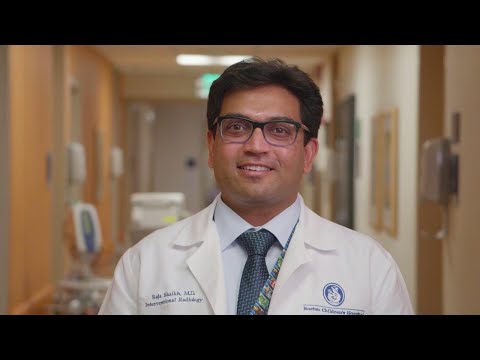
Caregiver Profile
Meet Dr. Raja Shaikh
Certifications
American Board of Radiology (Diagnostic Radiology)
Approach to Care
For me, health care is a very unique offering that one can provide to humanity. To make a positive difference in another being’s existence and see their joy is very fulfilling, especially in children. I would like to bring humane and healing virtues to all my patients and see them leave with a smile.
From a very early age my parents impressed upon me the idea of being of service to mankind, especially the poor and needy. My qualities of being gregarious and a good empathizer coupled with a penchant to excel in science immensely helped me to choose medicine as a career. I was passionate about surgery, but wanted to be able to “cut-out” the disease without causing much harm. Interventional radiology was exactly such field I was looking for to help the patients in the most minimally invasive manner. I was able to incorporate my love for caring for people and interest in science to become a physician.
From a very early age my parents impressed upon me the idea of being of service to mankind, especially the poor and needy. My qualities of being gregarious and a good empathizer coupled with a penchant to excel in science immensely helped me to choose medicine as a career. I was passionate about surgery, but wanted to be able to “cut-out” the disease without causing much harm. Interventional radiology was exactly such field I was looking for to help the patients in the most minimally invasive manner. I was able to incorporate my love for caring for people and interest in science to become a physician.
Publications
Cervical Intranodal Lymphangiogram in Pediatrics; Technique, Safety, and Clinical Applications. View Abstract
Qualitative evaluation of magnetic resonance imaging features in aneurysmal bone cysts after percutaneous cryoablation. View Abstract
Percutaneous removal of pulmonary intravascular foreign bodies in children. View Abstract
Cryoablation in Extra-Abdominal Desmoid Tumors: A 10-Year Experience in Pediatric and Young Adult Patients. View Abstract
Fibroadipose Vascular Anomaly: Diagnosis and Treatment. View Abstract
Thoracic duct drainage patterns in heterotaxy. View Abstract
Image-Guided Transrectal Drainage of Pelvic Abscesses in Children. View Abstract
Cryoablation for Bone and Soft Tissue Lesions in Pediatric Patients: Complications and Preventive Measures. View Abstract
Magnetic resonance three-dimensional steady-state free precession imaging of the thoracic duct in patients with Fontan circulation and its relationship to outcomes. View Abstract
A single-institution pediatric and young adult interventional oncology collaborative: Novel therapeutic options for relapsed/refractory solid tumors. View Abstract
Lymphatic Embolization for the Management of Post-operative Chyle Leaks Following Solid Tumor Resection in Pediatric Patients. View Abstract
Imaging of pediatric liver tumors: A COG Diagnostic Imaging Committee/SPR Oncology Committee White Paper. View Abstract
Imaging of pediatric extremity soft tissue tumors: A COG Diagnostic Imaging Committee/SPR Oncology Committee White Paper. View Abstract
Appendix to the Society of Interventional Radiology Consensus Guidelines for the Periprocedural Management of Thrombotic and Bleeding Risk in Patients Undergoing Percutaneous Image-Guided Interventions: Pediatric Considerations. View Abstract
The Use of an Inflatable Adhesive External Compression Device for Maintenance of Hemostasis following Angiography in Children. View Abstract
Fibrolamellar carcinoma: An entity all its own. View Abstract
Endovascular approaches in pediatric interventional oncology. View Abstract
The use of the internal mammary vein for central venous access. View Abstract
Two-hour Observation After Liver Biopsy in Children: Clinical and Economic Outcome of a Quality Improvement Intervention. View Abstract
Qualitative evaluation of MRI features in aneurysmal bone cysts after percutaneous sclerotherapy. View Abstract
Single Procedure Saline Lavage for Treatment of Inspissated Bile. View Abstract
Making the most of small samples: Optimization of tissue allocation of pediatric solid tumors for clinical and research use. View Abstract
Surgical Management of Fibroadipose Vascular Anomaly of the Lower Extremities. View Abstract
Clinical and imaging features in fibro-adipose vascular anomaly (FAVA). View Abstract
Multidisciplinary management of spinal aneurysmal bone cysts: A single-center experience. View Abstract
MR Imaging Evaluation of Pediatric Lymphatics:: Overview of Techniques and Imaging Findings. View Abstract
Characterization of long-term outcomes for pediatric patients with epithelioid hemangioma. View Abstract
Lymphaticovenous bypass of the thoracic duct for the treatment of chylous leak in central conducting lymphatic anomalies. View Abstract
Pulmonary thromboembolic events in patients with congenital lipomatous overgrowth, vascular malformations, epidermal nevi, and spinal/skeletal abnormalities and Klippel-Trénaunay syndrome. View Abstract
Endovascular Treatment of Congenital Arterioportal Fistulas. View Abstract
Percutaneous Image-Guided Cryoablation in Vascular Anomalies. View Abstract
Catheter-Directed Thrombolysis in a Child with Bilateral Renal Artery Graft Thrombosis. View Abstract
Imaging features of kaposiform lymphangiomatosis. View Abstract
Cryoablation in fibro-adipose vascular anomaly (FAVA): a minimally invasive treatment option. View Abstract
Misdiagnosis of plexiform neurofibroma as venous malformation in pediatric patients. View Abstract
Predictors of diagnostic success in image-guided pediatric soft-tissue biopsies. View Abstract
Percutaneous coil embolization of massive pelvic pseudoaneurysm in an infant. View Abstract
Subfascial involvement in glomuvenous malformation. View Abstract
Transjugular retrograde cannulation of the portal vein via patent ductus venosus: alternative access for endovascular hepatic interventions. View Abstract
Utility of the inversion scout sequence (TI scout) in diagnosing myocardial amyloid infiltration. View Abstract
Use of time resolved magnetic resonance imaging in the diagnosis of pelvic congestion syndrome. View Abstract
Callosal holes: an unusual imaging appearance in systemic lupus erythematosus. A case report. View Abstract