A new option for teens with painful bunions
In the rare cases that bunions require surgery, patients experience less pain and recover faster thanks to a new minimally invasive procedure. Orthopedic surgeon Dr. Collin May explains.


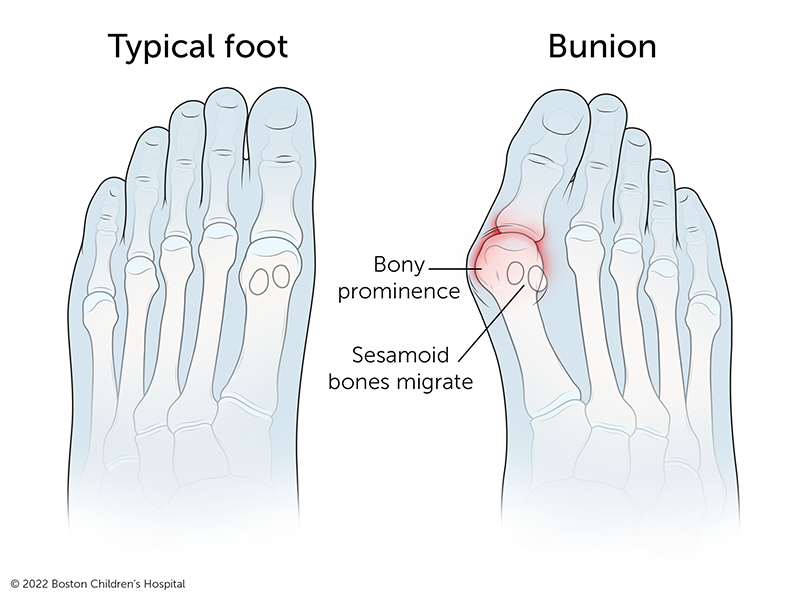
A bunion is a bony bump at the base of the big toe. It develops when the joint that connects the toe to the foot becomes enlarged and sticks out. When children have bunions, they typically have them in both feet.
Most bunions do not require treatment. However, some bunions grow larger over time, causing the big toe to angle in toward the second toe and making wearing any type of shoe is painful. As the big toe angles further toward the second toe, the bunion becomes more prominent. This can cause rubbing on shoes and irritation of the skin and tissue overlying the bone. The pressure from the big toe can force the second toe out of alignment, sometimes overlapping with the third toe.
While bunions are most common among adult women, they also can occur in tweens and teens between the ages of 10 and 15. Teenage girls are three times more likely than boys to get bunions.
The exact cause of bunions is unknown. In adolescents, bunions are often an inherited family trait.
Some conditions, such as cerebral palsy and Down syndrome, increase a child’s risk of having bunions.
In adults, tight shoes that squeeze the toes together can increase the risk of developing bunions, but this is rarely the cause in children.
Symptoms of adolescent bunions vary depending on how severe they are. While most bunions are not painful, symptoms can include:
Bunion symptoms may resemble other conditions or medical problems. Always consult your child's physician for a diagnosis.
Your child should be evaluated by a pediatric orthopedic specialist. The doctor will ask about your child’s medical history and perform a careful physical examination of your child. This will involve observing your child's:
The surgeon will also want to know what kind of shoes your child wears and what types of shoes aggravate the symptoms. They will try to determine whether any pain caused by the bunion is due to specific activities, and whether the bunion is causing any functional limitations.
X-ray imaging may be used to help determine the extent of the damage and deformity of the toe joint.
In the rare cases that bunions require surgery, patients experience less pain and recover faster thanks to a new minimally invasive procedure. Orthopedic surgeon Dr. Collin May explains.
Most bunions, particularly in teenagers, can be managed without surgery. The first step is often replacing tight shoes with shoes that don’t press against the bunions or cause your child pain when they walk. Your child's orthopedic surgeon can give you information about the types of shoes and proper shoe fit. Here are some general rules for selecting shoes:
Some shoes (and skates or ski boots) can be made more comfortable by stretching the areas that put pressure on your child's big toes.
Your child should wear their well-fitting shoes all the time. Switching back to poorly fitting shoes that squeeze the toes will be painful and could increase the risk that your child’s bunions will become larger and more painful.
Your child's orthopedic surgeon may recommend splints to reposition the big toe and special shoe inserts (orthotics). Orthotics are padding shaped to your child’s feet to help relieve pain from bunions.
Surgery is not recommended for teenagers with bunions unless they have first replaced poorly fitting shoes, are using an orthotic, or both. If they still have severe foot pain that limits their everyday activities, surgery may be an option.
The goal of surgery is to relieve pain and correct the deformity. Surgery for cosmetic reasons alone is not recommended.
Some of the most common bunion surgeries include:
The Lower Extremity Program at Boston Children's Hospital offers comprehensive assessment, diagnosis, and treatment for children of all ages with bunions and other conditions affecting their lower limbs. We have extensive experience treating disorders of the feet, ankles, knees, legs, and hips. Whether the patient is an infant, child, or adolescent, our goal is to help children live full, independent lives.