Popular Search Terms


The Facial Reanimation Program at Boston Children's Hospital is made up of an expert team of professionals dedicated to the care of children with facial nerve problems.
We treat all aspects of facial nerve paralysis and paresis, including those due to congenital and traumatic conditions, palsy after tumor removal, and Moebius syndrome.
Smiling, blinking, and frowning
The facial nerve controls expressions such as smiling, blinking, and frowning.
- Facial nerve palsy can be congenital or acquired.
- Congenital facial nerve palsy is present at birth and can affect one or both sides of the face.
- Acquired facial nerve palsy develops because of trauma, inflammation, or infection, or after removal of tumors in the head and neck.
Here at Boston Children's Hospital, our experienced, compassionate team of physicians understands that lack of facial expression or facial muscle tone can cause a variety of functional and social problems for your child.
That's why we make it our business to offer the latest and best treatments — so that your child can live a happy and healthy life.
Our expertise
Boston Children's Facial Reanimation Program is focused on fixing your child's facial nerve problems. Here's how we do it:
- Sometimes, we'll use your child's own tissues to improve both looks and function around the eye and the mouth.
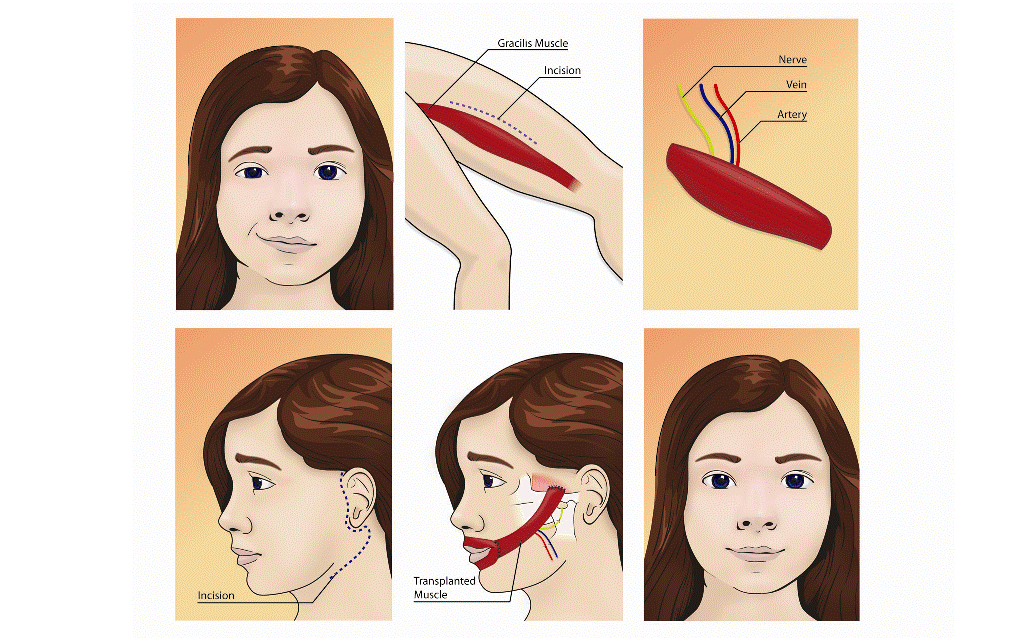
- We'll often need to do what's called a dynamic muscle transfer to help your child smile and use her lips effectively.
- Our doctors will try to minimize the side effects of surgery by using microsurgical techniques that reduce scarring and improve recovery times — getting your child home and healthy faster.
The facial nerve
The facial nerve exits the skull behind the ear and penetrates the parotid gland within the cheek. There, it splits into multiple branches that control a specific set of facial muscles. The activity of the nerve controls facial expressions such as smiling, blinking and frowning.
Facial nerve palsy
Facial nerve palsy can be congenital or acquired.
- Congenital facial nerve palsy is present at birth. It can be associated with other conditions, such as Moebius syndrome, or it can be an isolated condition. When due to Moebius syndrome, it usually affects both sides of the face. When an isolated condition, it usually affects only one side of the face. The cause of isolated congenital nerve palsy is not known.
- Acquired facial nerve palsy develops because of trauma, inflammation, or infection or after removal of tumors in the head and neck.
Lack of facial expression or facial muscle tone can cause a variety of functional and social problems:
- Most commonly, it affects the eye and the mouth.
- If the eyelid cannot close, the eye is more prone to injury such as corneal abrasions or scratches.
- Sucking and chewing can be difficult and drooling may occur.
- The child may not be able to smile on one side, and this can cause significant psychological distress.