Popular Search Terms


What is clinodactyly?
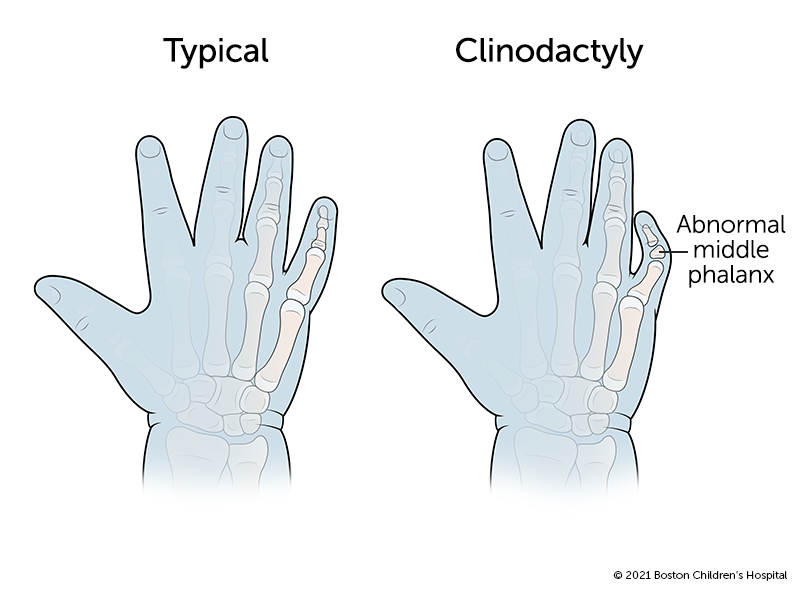
Clinodactyly means that your child has a finger that curves to one side. It usually affects the little (pinky) finger but can affect other fingers as well. It is typically caused by abnormal growth and development of the small bones of the finger.
How common is clinodactyly?
Clinodactyly is a common condition. While the exact number is not known, about 10 percent of children are affected by clinodactyly to some degree. It tends to affect boys more often than girls.
Having clinodactyly in both hands is also common.
Symptoms & Causes
What causes clinodactyly?
There are three bones in the finger. In many cases, children develop clinodactyly when the middle bone is shaped like a triangle. This misshapen bone is called a “delta phalanx.” A delta phalanx may have a curved growth plate or more than one growth plate. Therefore, as the hand grows, the finger becomes more curved.
Clinodactyly can be passed on from parent to child. It may also be part of a related condition, such as Down syndrome.
Diagnosis & Treatments
How is clinodactyly diagnosed?
Your child’s doctor will diagnose clinodactyly after talking with you about your child’s medical history and doing a careful physical examination. Your child will also have an X-ray.
How is clinodactyly treated?
Treatment for clinodactyly depends on how curved your child’s finger is.
Mild clinodactyly usually does not cause pain or problems with function. If your child has a mild curve, they probably do not need surgery.
However, clinodactyly can increase as the hand and fingers grow. Therefore, it is important for your child to be followed closely by their doctor in case their finger becomes more curved over time.
If clinodactyly interferes with the use or movement of their hand, your child may need surgery.
There are two main types of surgery for clinodactyly:
- Physiolysis is done in very young children who have a delta phalanx (triangle-shaped bone) that is causing their finger to grow more curved. The abnormal growth plate in the delta phalanx is removed so the finger can grow more normally.
- Osteotomy is typically done in younger children with a more severe curve, and in older children and teenagers who have trouble using their hand due to the curved bone. In an osteotomy procedure, the curved bone is cut and straightened. It is generally held in place with pins and a cast until it heals.
Surgery is usually successful in fixing the curve, but there is a risk that it the curve will come back. If it does, your child may need another surgery.
How we care for clinodactyly at Boston Children’s Hospital
The Orthopedics and Sports Medicine Department’s Hand and Orthopedic Upper Extremity Program and our Department of Plastic and Oral Surgery’s Hand and Reconstructive Microsurgery Program have treated thousands of babies and children with clinodactyly and other hand problems. We are experienced treating conditions that range from routine to highly complex, and can provide your child with expert diagnosis, treatment, and care. We also offer the benefits of some of the most advanced clinical and scientific research in the world.
Our Orthopedics and Sports Medicine Department is nationally known as the preeminent center for the care of children and young adults with a wide range of developmental, congenital, neuromuscular, sports-related, traumatic, and post-traumatic problems of the musculoskeletal system.
Our Department of Plastic and Oral Surgery is one of the largest and most experienced pediatric plastic and oral surgery centers anywhere in the world. We provide comprehensive care and treatment for a wide variety of congenital and acquired conditions, including hand deformities.
Practitioners Who Specialize In This Condition (5)

Carley Vuillermin, MBBS, MPH, FRACS
Orthopedic Surgeon, Orthopedics and Sports Medicine Department
Associate Professor of Orthopedic Surgery, Harvard Medical School

Daniel M. Balkin, MD, PhD
Attending Physician, Department of Plastic & Oral Surgery
Instructor of Surgery, Harvard Medical School
