Popular Search Terms
Overview
Symptoms & Causes
Diagnosis & Treatments
Research & Innovation
Related Programs & Services
Contact Us


What is Ebstein’s anomaly?
Ebstein’s anomaly is a rare heart defect that affects the tricuspid valve. Ebstein’s anomaly has a wide range of severity — from mild to severe. About one in 10,000 babies is born with this condition.
In a normal heart, the tricuspid valve controls blood flowing from the right atrium (upper heart chamber) to the right ventricle (lower heart chamber). The valve has three flaps, called leaflets. These leaflets open to allow blood to flow from the right atrium to the right ventricle and close to prevent blood from moving back into the right atrium when the heart pumps.
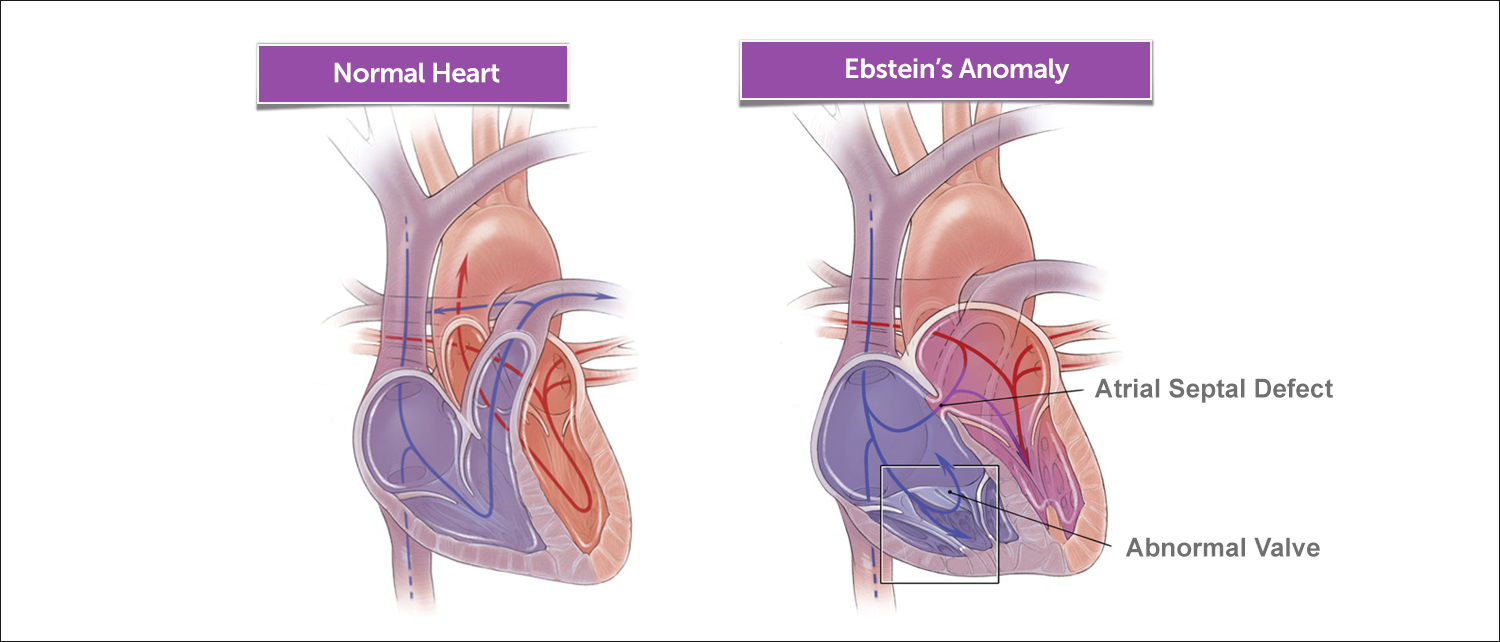
In Ebstein’s anomaly, the leaflets are malformed and are positioned too low in the right ventricle. Sometimes, one of the leaflets is displaced downward into the ventricle, while another leaflet is larger than usual and may be abnormally attached to the wall of the ventricle. This causes enlargement of the atrium, and it can lead to congestive heart failure — a back-up of blood flow that results in a fluid buildup in the body.
Children with Ebstein’s anomaly can also have other heart defects, including atrial septal defect or pulmonary valve stenosis.
Symptoms & Causes
What are the symptoms of Ebstein’s anomaly?
The most common sign of Ebstein’s anomaly in newborns and infants is a blue coloration of the skin, lips, or nails (cyanosis). In some severe cases, the infant may have trouble breathing.
Older children may have the following symptoms:
- Cough
- Rapid breathing or shortness of breath
- Slow growth
- Fatigue
- Fast heartbeat
- Swelling
- Irregular heartbeat
What are the causes of Ebstein’s anomaly?
In some cases, Ebstein’s anomaly has been associated with lithium exposure, but in most cases the cause is unknown.
Diagnosis & Treatments
How is Ebstein’s anomaly diagnosed?
If your newborn baby is born with a bluish tint to the skin, or your child’s pediatrician suspects a heart condition, you will be referred to a pediatric cardiologist for a physical exam. The doctor will listen to your baby’s heart and lungs, measure the oxygen level in his or her blood (non-invasively), and make other observations to help determine the diagnosis.
If the doctor hears a heart murmur, the sound and character of the murmur and its location in the chest will give the cardiologist an idea of the kind of heart problem your baby may have.
In some cases, Ebstein’s anomaly is found before birth during a fetal ultrasound.
The doctor may order one or more of the following tests to help with the diagnosis:
- Echocardiogram (cardiac ultrasound)
- Cardiac magnetic resonance imaging (MRI)
- Chest X-ray
- Electrocardiogram (EKG or ECG)
How is Ebstein’s anomaly treated?
Non-surgical
Treatment depends on the severity of the child’s anomaly. Children with a mild anomaly may be able to use medication alone to control symptoms, including:
- The fluid build-up that causes congestive heart failure
- Abnormal heart rhythms (arrhythmias)
- Abnormal heart rate
Children who have arrhythmias and heartbeat irregularities that cannot be controlled by medication may need a procedure, called radiofrequency catheter ablation, to treat these heart arrhythmias.
Surgical
There are several surgical options for repairing your child's tricuspid valve and repairing other defects that are associated with Ebstein's anomaly. These techniques include:
- Cone procedure: In this procedure, extra tissues on the enlarged right side of the heart are folded up, and the malformed valve is surgically reshaped into a cone that opens and closes.
- Surgical valve repair: Surgeons reposition the existing valve and reconfigure the shape of the tricuspid valve leaflets.
- Tricuspid valve replacement: If a child’s tricuspid valve is too malformed to be repaired, the existing valve will need to be replaced with a mechanical valve or a bioprosthetic valve, made of human or animal tissue.
- Bidirectional Glenn procedure: When the right ventricle is not adequate in size sometimes the bidirectional Glenn procedure is needed as well.
In children who can’t be treated with a catheter, arrhythmias are addressed at the time of surgery with surgical ablation.
What is the long-term outlook for children with Ebstein’s anomaly?
Treatments for Ebstein's anomaly are continually being refined, and the long-term outlook is continually improving. Most children who've had surgery recover and grow normally.
Even so, your child will need periodic monitoring — and possibly medication — since he or she could be at some risk for abnormal heart rhythms (arrhythmias) and heart failure. In a few cases, children who have had surgery for Ebstein's anomaly may need additional surgery.
Your child's cardiologist will help you create a long-term care program as your baby matures into childhood, the teen years, and adulthood, where they are followed by the Adult Congenital Heart Program. Most people who have had congenital heart disease repair have an ongoing relationship with their cardiologist.
How we care for Ebstein’s anomaly
The Boston Children’s Hospital Benderson Family Heart Center cares for children with congenital heart defects that involve absent or malfunctioning heart valves. Our surgeons have a strong record of excellence in heart-valve repair and replacement, including minimally-invasive techniques.
Boston Children's is one the select heart centers in the U.S. that performs the advanced and innovative “cone procedure” for repairing the tricuspid valve in children with Ebstein's anomaly.
Many patients with Ebstein’s also have arrhythmias called pre-excitation and Wolff-Parkinson-White syndrome. Our specialized team of electrophysiologists diagnose and treat these arrhythmias.
Research & Innovation
Our areas of innovation for Ebstein’s anomaly
Pediatric cardiologists and pediatric cardiac surgeons at Boston Children's have pioneered the interventional catheterization and surgical techniques now used widely for many congenital heart defects, such as Ebstein’s anomaly.
Practitioners Who Specialize In This Condition (3)

Aditya "AK" Kaza, MD, MBA
Cardiac Surgeon, Department of Cardiac Surgery; Director, Neonatal Cardiac Surgery Program; Surgical Medical Director, Patient-Flow and Capacity Center
Associate Professor of Surgery, Harvard Medical School


Jun Sasaki, MD
Associate Cardiologist, Department of Cardiology
Assistant Professor, Harvard Medical School
